
Pingo AI Review: Is It Worth It in 2026?
The Bottom Line
Pingo AI offers AI-powered conversation practice in 25+ languages. After testing it extensively in French and Spanish, I found significant gaps between what it promises and what it delivers. The app has a clean interface and does a reasonable job getting beginners speaking. However, the content is shallow, the speech recognition is far too lenient, and the custom lesson feature doesn't deliver on its promise. For learners who want depth, accurate feedback, or meaningful customization, Langua is a significantly more capable app.
Overall rating: ⭐⭐⭐ 3 stars out of 5
In-Depth Pingo AI Review
Below, you'll find a detailed look at Pingo AI's performance across the core areas that matter most: conversation quality, audio and speech recognition, lesson design, feedback depth, vocabulary tools, and grammar support.
But first, here's a quick overview of the app's strengths and weaknesses.
Pingo AI Pros & Cons
Pros
- Clean, modern interface with a straightforward lesson selection screen.
- Large selection of conversation topics and structured beginner lessons.
- Vocabulary saving and transcript export after each lesson.
Cons
- Content is shallow and oriented almost entirely toward beginners.
- Speech recognition is far too forgiving, accepting incorrect pronunciation and even wrong words.
- Custom lessons don't adapt to your level or produce meaningful, targeted practice.
- No spaced repetition or long-term vocabulary tracking.
- Limited feedback that doesn't help learners understand or correct their mistakes.
Conversation Quality & AI Intelligence
Pingo AI structures its speaking practice around themed lessons and custom roleplays. The themed lessons cover familiar beginner topics: family, basic verbs, simple sentences, transitions, and expressing interest and surprise. Each lesson provides a short overview of what you'll learn before you begin, and the AI guides you through vocabulary and short exchanges.
For basic exchanges, the AI performs decently. It introduces vocabulary in context, prompts you to repeat phrases, and offers gentle corrections when it detects an error.
The conversations are functional, if somewhat rigid. Pingo tends to follow a predictable pattern: introduce a word, ask you to say it, confirm, move on.
The custom roleplay feature sounds better than it performs. You can define your role, Pingo's role, and the scenario context, or let the app generate a scenario for you.
In practice, however, the roleplays I tested were basic and didn't adapt to my input in any meaningful way. The AI stuck to simple exchanges regardless of how complex my responses were.
Testing the app in both French and Spanish, I found that the conversations work best at a very early beginner level. Once you're past the basics, the interactions start to feel repetitive and underwhelming. The AI doesn't adjust its complexity based on your performance, and there's no sense of progression within a conversation.
By contrast, Langua offers more dynamic conversations. The AI remembers context, adjusts to your proficiency, and can drift between topics in a way that feels more natural. Pingo's conversations, while functional, don't come close to that level of flexibility.
Audio Quality & Speech Recognition
Pingo's audio quality is serviceable. The AI voice is clear but sounds unnatural compared to a real person. It's a step above the robotic voices found in some competitors, but it doesn't feel particularly lifelike either.
The bigger issue is speech recognition, which is far too forgiving. During my testing I deliberately said things incorrectly (mispronouncing words, using the wrong vocabulary, and even making grammatical errors), and the app usually just accepted my response and moved on.
In one French lesson, I intentionally said nonsense syllables and Pingo still praised my effort and continued.
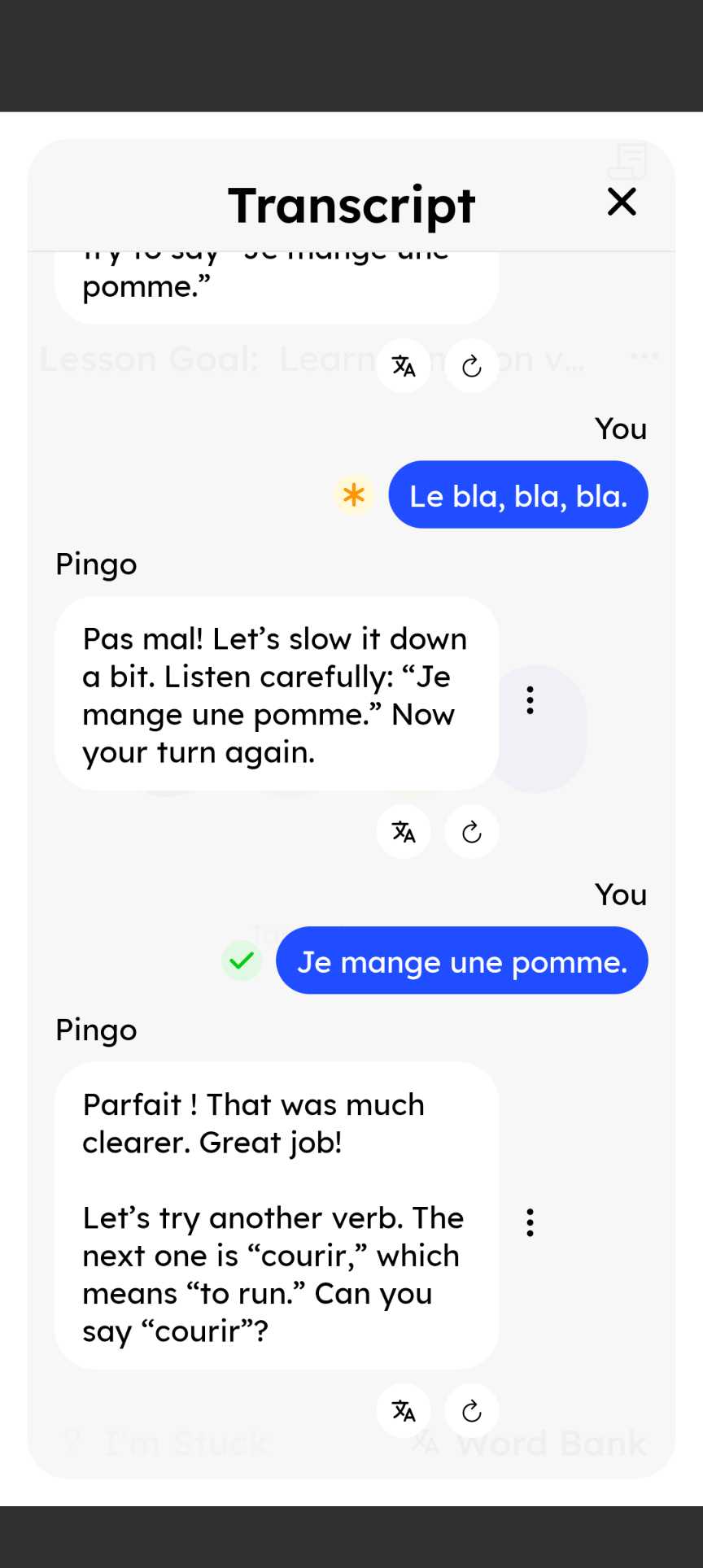
This leniency is a serious problem for anyone trying to actually improve. If the app doesn't catch mistakes, you'll keep making them. Pronunciation is one of the hardest aspects of language learning to self-correct, and an AI tutor that lets everything slide defeats the purpose of speaking practice.
Langua, by comparison, uses more accurate speech recognition, making it far more useful for learners who want to build genuine speaking skills rather than just go through the motions.
Structured Course & Lesson Design
Pingo's structured lessons are organized into themed topics like "Basic Verbs," "Family," "Basic Transitions," and "Express Interest and Surprise." Each lesson includes a brief overview listing two or three learning objectives, followed by guided conversation practice. Lessons run 4-5 minutes and end with a summary showing new vocabulary, a mastery percentage, and your time spent.
The beginner content is reasonably well-organized. The app introduces vocabulary in context and gives you opportunities to practice using new words in simple sentences.
The lesson summaries with vocabulary lists and example sentences are a nice touch, and the ability to export transcripts is genuinely useful for review.
However, almost all content targets beginners only. The topics are basic, the sentences are simple, and there's little sense of progression from one lesson to the next. If you already know how to say "I eat an apple" and "I run every morning," you'll find much of the course material too easy.
The gamification elements like streak tracking, mastery percentages, and encouraging messages are standard for apps in this category. They may help with motivation for some learners, but they don't compensate for the limited depth of the actual content.
Feedback Quality & Depth
Feedback is one of Pingo's weakest areas. After each lesson, you get a summary showing how many new vocabulary items you encountered, a mastery percentage, and the time you spent. But this tells you very little about what you actually did well or poorly.
During conversations, Pingo offers brief, encouraging corrections like "Pas mal! Let's slow it down a bit" before re-prompting you. These work for complete beginners, but that's as deep as they get.
There's no analysis of your pronunciation patterns, no breakdown of grammatical errors, and no tracking of recurring mistakes over time.
The mastery percentage displayed at the end of each lesson is misleading. Given how forgiving the speech recognition is, you can score 85% or higher even when making significant errors. This gives you a false sense of progress that doesn't match your real ability.
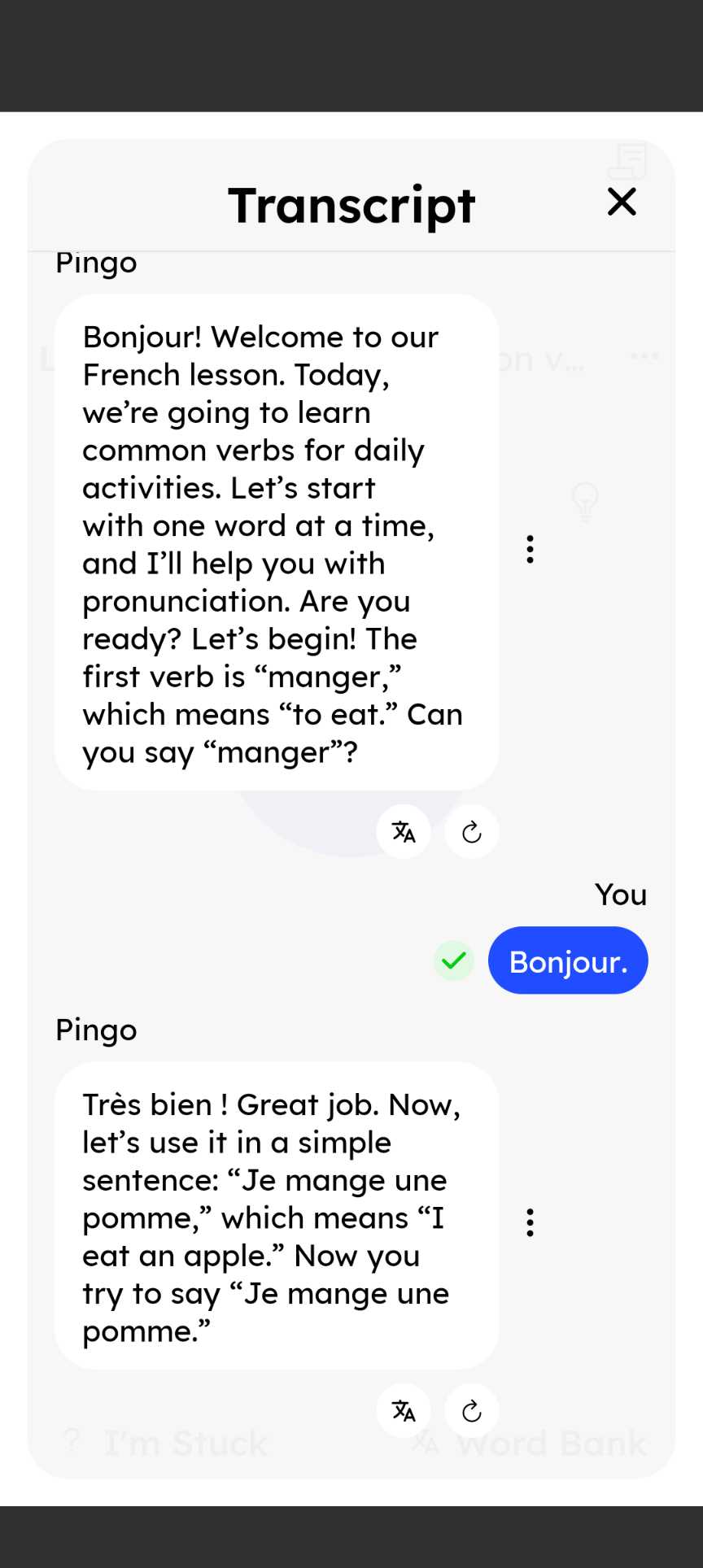
Pingo AI reviews elsewhere have highlighted that the app's feedback system lacks depth, and this remains one of its most significant shortcomings.
Langua provides far richer and more actionable feedback after each conversation, including categorized error lists and follow-up exercises targeted at your specific weak areas. For learners who want to actually improve, this kind of detailed feedback is essential, and it's exactly what Pingo lacks.
Vocabulary-Building Tools
Pingo presents new vocabulary within the flow of conversation, which is a sound pedagogical approach. Each lesson summary lists the new words and phrases you encountered, complete with example sentences and audio playback. You can bookmark items for later review and export lesson transcripts.
However, the vocabulary system has significant limitations. There's no spaced repetition to ensure long-term retention. Saved words sit in a list but are never systematically reintroduced in future lessons or conversations. There's no way to create custom vocabulary sets, and no integration between the vocabulary you've saved and the lessons you're assigned.
Many AI apps have this problem, but it's worse in Pingo because lessons are so short. You'll encounter 4 to 14 new items per session, but without any mechanism to reinforce them, retention is largely left to chance.
Langua handles vocabulary much more effectively, incorporating saved words into future conversations and offering multiple review modes with spaced repetition built in.
Grammar Support
Pingo has a custom lesson feature that should let you create grammar lessons, but it doesn't work well. The app's approach is entirely conversation-based, which means grammar is only addressed incidentally (if at all) during speaking practice.
When I tried to create a custom lesson to teach the French subjunctive, the app started by teaching me the word "que" ("that"), a word that anyone studying the subjunctive would certainly already know, and then took me through a series of very simple drills.
On subsequent attempts, I tried to get Pingo to provide a more focused, detailed lesson on the subjunctive, but was unsuccessful each time.
By contrast, Langua creates grammar drills based on your most frequent mistakes, as well as giving you an option to create your own custom exercises. This level of customization is exactly what Pingo's feature promises but fails to deliver.
For learners who like to understand the "why" behind the language, Pingo offers very little. You'll need to look elsewhere for grammar explanations, which somewhat undermines the value of an all-in-one language app.
Pingo AI Pricing
Pingo AI offers a free trial with limited access. After that, there are two main subscription options: $14.99 per month or $99.99 per year (marketed as a 45% discount). On the App Store, a "Pingo Pro" option is also listed at $83.99, though it's not entirely clear how this differs from the standard annual plan.
The paid subscription unlocks unlimited conversations, custom roleplays, vocabulary tools, and full progress tracking. The free version is enough to get a feel for the interface, but not to evaluate the learning experience in any meaningful depth.
Pingo AI Alternatives
Best Overall Alternative: Langua
For learners who want a complete, adaptive language learning experience, Langua is the strongest alternative to Pingo AI. It outperforms Pingo in virtually every category that matters:
- Conversations are more natural, context-aware, and adaptive to your level.
- Select from numerous AI characters with different dialects, all cloned from native speakers so they are remarkably realistic.
- Speech recognition is more accurate, catching errors that Pingo overlooks entirely.
- Detailed post-chat feedback helps you track patterns in your mistakes and improve over time.
- Vocabulary integrates seamlessly into future conversations and review sessions.
- Custom prompts give you genuine control over your learning, not just surface-level customization.
It's also competitively priced and offers more value for serious learners at every level.
Budget Alternative: TalkPal
TalkPal offers AI-driven conversations at a lower price, with playful scenarios and easy-to-use chat options. Its voices and feedback are less advanced than Pingo's, and lessons don't form a structured curriculum. It's a reasonable choice for casual learners who value fun over structure, but anyone hoping to make serious progress may outgrow it quickly.
Free Option (With Limitations): ChatGPT
ChatGPT can serve as a free conversation partner, but it lacks specialized features for language learning:
- No structured lessons or conversation scenarios designed for learners.
- The AI doesn't know to correct your mistakes unless you specifically ask.
- No integrated feedback, progress tracking, or pronunciation assessment.
- Speech detection can cut you off mid-sentence.
It's primarily an option for advanced learners who want unstructured conversation practice, rather than for beginners or intermediate learners.
Final Verdict
Pingo AI has a polished interface and a solid concept: get learners speaking through conversation from day one. But once you dig deeper, the cracks show. The content is too shallow for anyone beyond the absolute beginner level. The speech recognition is so forgiving that it undermines the core value of speaking practice. The custom lesson feature, potentially Pingo's most useful tool, fails to produce lessons that are targeted or challenging enough to be useful. And the feedback system offers encouragement without substance.
If you're a complete beginner who just wants a low-pressure way to hear and repeat basic phrases, Pingo might serve as a starting point. But for learners who want accurate feedback, meaningful customization, and a system that actually adapts to their level, Langua is my top recommendation for learning a language with AI.