Speak App Review: Is It Worth It In 2026?
The Bottom Line
Speak remains one of the more polished AI-based speaking apps available. The speech recognition is accurate, though it sometimes corrects your speech, which isn't ideal (as you don't notice your errors). The voices are natural, however accent and voice options are limited.
The app's feedback and customization features are unlikely to satisfy serious learners. The course structure works well for beginners, but at higher levels it starts to feel repetitive, and there’s little integration between the structured course, free conversations, and personalized review features.
Speak can work well for early learners who want to start speaking quickly with AI, but for those aiming to build real-world fluency through varied and adaptive practice, Langua is a more complete app.
Overall rating: ⭐⭐⭐ 3 stars out of 5.
In-Depth Speak App Review
Below, you'll learn how the app performs across all the most important aspects: conversation quality and intelligence, lesson design, audio and speech recognition, feedback depth, vocabulary tools, and grammar support. But first up in this Speak app review, a quick summary of the pros and cons.
Speak Pros & Cons
Pros
- Clear voices and accurate speech recognition.
- Engaging “Roleplay” and “Free Talk” lessons with cultural context.
- Flexible “Speak Tutor” for grammar questions and custom lessons.
- Polished, intuitive interface and well-paced beginner content.
Cons
- Feedback is brief and lacks depth or personalization.
- Lack of variety in lesson types.
- No spaced repetition or long-term vocabulary tracking.
- Premium tier structure is confusing and potentially expensive.
- Limited control over voices, accents, and conversation behavior.
Conversation Quality & AI Intelligence
Speak divides its speaking activities into several modes, each offering a different degree of guidance and freedom. The “Roleplay” and “Free Talk” sections are where its AI capabilities shine.
In roleplays, you choose a scenario (like “At a Coffee Shop” or “Making New Year’s Resolutions”) and the app gives you three tasks to complete during the conversation. The roleplay ends automatically when you’ve completed the tasks, or when the interaction has come to its natural conclusion.
The “Free Talk” option is more open-ended: you define the roles, topic, and setting yourself. The AI performs reasonably well here, recognizing nuanced sentences and maintaining flow, but it tends to end nearly every response with a question, which often feels unnatural and forced. Even if you avoid setting a specific objective or subject matter, it often ends up feeling more like an interrogation than a friendly conversation.
By contrast, Langua, my favorite AI language learning app, has an option to prevent the conversation partner from always asking a question. I’m often surprised at how my chats with Langua drift naturally to different topics in a way that feels almost human.
Audio Quality & Speech Recognition
Speak’s audio quality is strong: the voices are smooth and easy to understand, with none of the robotic stiffness common in older AI tutors. Unfortunately, there’s no option to choose from multiple voices or regional accents. This is less of an issue for beginners, but for intermediate and advanced learners who might want to focus on a specific regional language variant it could be a significant limitation.
As some Speak reviews on the app stores have mentioned, speech recognition is overly lenient. In “Speaking Drill” lessons, for instance, you can mispronounce words or even reverse the word order entirely and still receive a perfect score.
This is a major flaw: in French, for example, adjectives can have different meanings depending on whether they come before or after the noun they modify, but the app doesn’t correct such errors. This leniency can give a false sense of mastery, especially during the early, repetition-heavy lessons.
Structured Course & Lesson Design
Speak’s structured course is divided into short, thematic units, each made up of five main lesson types:
- Tutor Lesson: A guided lesson (sometimes with video) introducing pronunciation or vocabulary. Common in beginner units but rare later.

- Speaking Drill: Sentence-repetition exercises similar to Duolingo’s speaking mode, where words light up as you say them. Recognition is good but forgiving, and it doesn’t penalize word-order mistakes even if they would change the meaning of the sentence.
- Vocab Builder: Reinforces new words with simple matching and fill-in-the-blank games.
- Roleplay: These are the same as the roleplay lessons elsewhere in the app, but are focused on the vocabulary you’ve learned during a unit of the course.
- Tutor Q&A: Structured exchanges where the AI tutor asks a question and expects a specific response. These are useful for beginners learning set phrases, but feel repetitive and boring at higher levels.
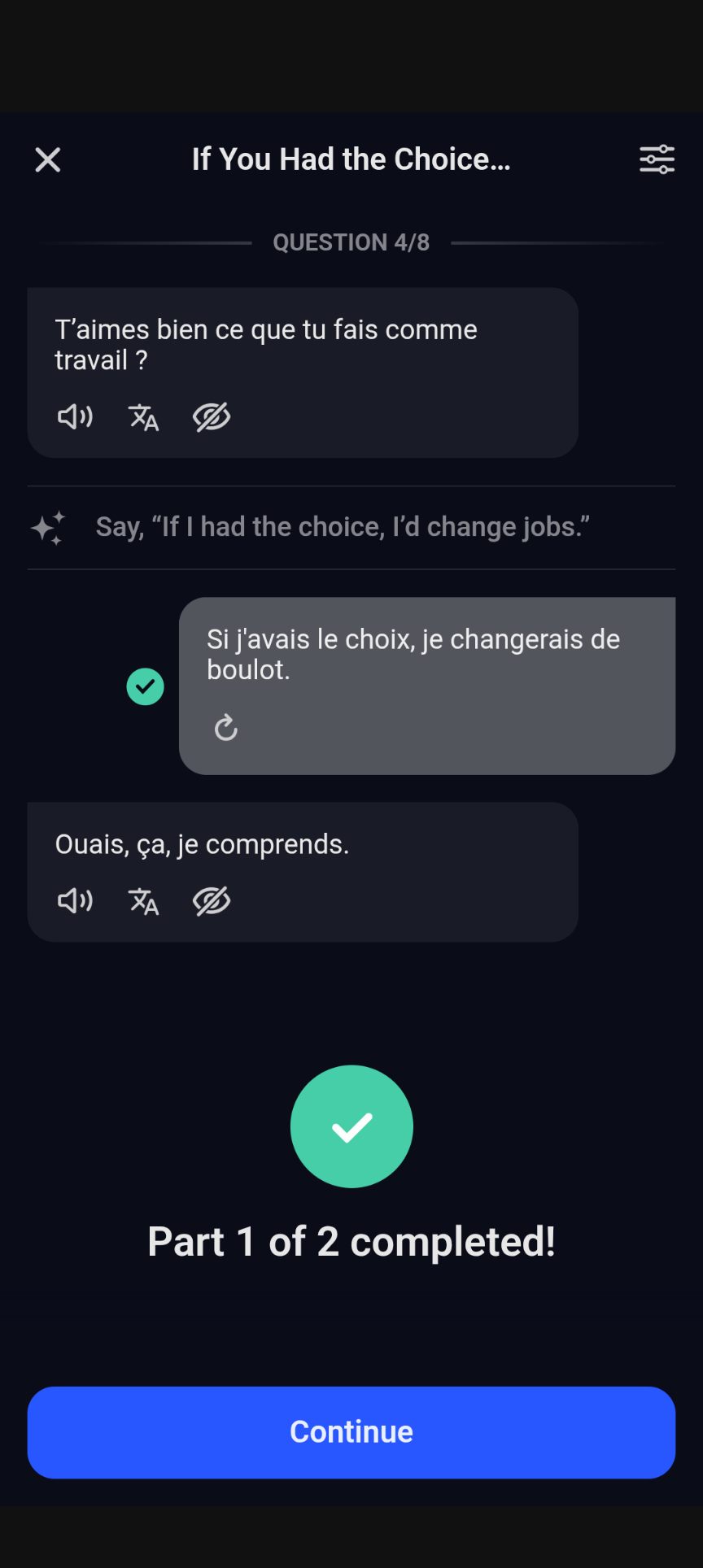
These lesson types aren’t evenly distributed across the different levels of the course: Tutor Lessons and Vocab Builders are frequent at the beginner level but almost completely absent from the intermediate and advanced levels, whereas Roleplay lessons aren’t introduced until the upper-elementary level.
This design makes the beginner curriculum clear and accessible, but as you progress the limited variety becomes noticeable.
Feedback Quality & Depth
Feedback is one of Speak’s weakest points. After each roleplay, you get a short summary of errors, and you can choose to generate a review lesson based on them. These “reviews” are just Speaking Drills that repeat similar sentence structures. There’s no discussion of grammar or pronunciation patterns, and no cumulative tracking of recurring mistakes.
Langua, by comparison, gives far richer and more actionable feedback, making it easy for learners to track their weakest areas and improve over time.
Vocabulary-Building Tools
Speak mostly avoids isolated word lists, preferring to introduce vocabulary in full-sentence contexts, which is a sound pedagogical choice supported by modern research.
You can save phrases from lessons to a personal “Phrasebook” for later review, but there’s no real tracking system to ensure long-term retention: the Review tab simply offers Speaking Drill-style exercises, with no variation and no option to delve deeper into a topic.
This one-way system, where phrases can be saved but never reintegrated into chats or new lessons, limits how effectively learners can build and reinforce their vocabulary over time.
Grammar Support
Speak doesn’t include structured grammar lessons, though you can ask the Speak Tutor to create one for you. In theory this is a powerful feature, but in practice it’s underwhelming. When asked to create a lesson on the French subjunctive, for example, the app generated yet another Speaking Drill with example sentences rather than an explanation or guided practice.
If you ask the Tutor to explain a grammar concept directly, it does provide a short text-based explanation, but these explanations could be improved a lot.
Speak App Pricing
Speak offers two main subscription tiers: Premium and Premium Plus, though the differences aren’t entirely clear at signup. Both tiers include the Speak Tutor and core lessons, but only Premium Plus offers unlimited custom lessons. Premium users face unspecified limits, which is frustrating given the wide price gap between tiers.
The “Made for You” page is one feature available only to Premium Plus users. It provides personalized lessons based on your mistakes, but the lessons are just more Speaking Drills, and the page only unlocks after completing a Free Talk session, making it less useful for absolute beginners.
Speak App Alternatives
Best Overall Alternative: Langua
For learners who want a complete, adaptive ecosystem rather than isolated drills, Langua is a more powerful alternative to Speak. It's a clear step up in almost every category that matters for sustained language learning:
- Conversations are more dynamic and context-aware, meaning you can digress or change topics without confusing the AI.
- Deeper and more actionable feedback is available at the end of every chat, along with a complete transcript of your conversation.
- Vocabulary tools and grammar support are seamlessly integrated into conversations. When you learn a new word, you’ll see it appear in later chats and review sessions.
- The AI partners sound more human, and you can choose from numerous voices across multiple dialects.
- The pricing is more transparent, and cheaper than Speak’s Premium Plus tier.
Budget Alternative: Talkpal
Talkpal offers AI-driven conversations at a lower price, and its lessons are structured around light, imaginative scenarios. It’s entertaining and easy to use, but less pedagogically grounded. Voices are serviceable but synthetic, feedback is minimal, and there’s little sense of continuity between lessons.
Compared to Speak, Talkpal feels less polished but also less constrained, making it a reasonable choice for casual learners who value fun over structure. But anyone hoping to reach fluency or have an almost human conversation partner may outgrow it quickly. You can read my in-depth Talkpal review here.
Free but no features tailored for language learning: ChatGPT
ChatGPT can be used as a free conversation partner. But it's not specifically designed for language learning, so it has various limitations:
- It lacks varied conversation scenarios designed for learners, so chats become repetitive quickly
- The AI doesn't know to correct your mistakes. You can ask it to, but it often forgets or doesn't do so in an optimal way for learning.
- It lacks integrated feedback and progress tracking.
- The AI also frequently cut me off mid-sentence because its speech detection isn't built for learners who need time to form sentences.
- It doesn't display text in speaking mode, so you cannot read what you've heard or access translations.
It's best suited for advanced learners who want to maintain fluency with casual practice, and don't mind dealing with its quirks.
Final Verdict
Speak succeeds in making AI conversation feel approachable and structured. Its clear voices, flexible speaking practice, and helpful Tutor feature make it a strong choice for beginners.
If you’re starting out in a new language and want an engaging, low-stress way to speak from day one, Speak might be worth a try. However, limited feedback, flexibility and personalization prevent it from reaching the same level as Langua, my top pick.