The Best Duolingo Alternatives in 2026: What to Use Instead (or Alongside)
Duolingo is brilliant at one thing: getting you to open a language app every day. But plenty of learners reach a 300-day streak and still freeze when someone actually speaks to them.
For this guide, a team of product experts and language tutors tested dozens of tools and narrowed it down to these Duolingo alternatives. We looked at what each app teaches better than Duolingo and where Duolingo still wins.
The short version: there's no single better Duolingo. The right alternative depends on what Duolingo isn't giving you.
Duolingo alternatives at a glance
| App | Best for | Speaking practice | Free option | Price from |
|---|---|---|---|---|
| Langua | Speaking practice with detailed feedback | Hundreds of dynamic conversational exercises, both free-flowing and a structured course for beginners | Free trial | $12.50/mo (annual plan) |
| italki | Conversation with a human tutor | Live human | No (discounted trial lessons) | Approx $10 to $40/lesson |
| ChatGPT / Gemini | Do-it-yourself practice on a budget | Open AI conversation (no learning system) | Yes, with limits | $8/mo (ChatGPT Go) |
| Babbel | Structured lessons with clear grammar | Scripted, plus AI beta | One free lesson | ~$9/mo on an annual plan |
| Busuu | A CEFR-aligned course with community feedback | Scripted; AI in top plan | Yes | Paid Premium plans (price varies by platform) |
| Rocket Languages | In-depth lessons you pay for once | Record-and-compare | Free trial lessons | ~$150 per level (frequent sales) |
| Podcasts & YouTube | Listening practice | None | Free | Free |
| Anki | Remembering vocabulary long term | None | Yes (except iOS) | Free; $24.99 one-time on iOS |
| Memrise | Vocabulary with native-speaker video clips | AI roleplays (limited free) | Yes | $61.99/yr (about $5/mo) |
| Kwiziq | Targeted French and Spanish grammar | None | 10 quizzes a month | ~$11.50/mo on an annual plan |
How we chose these: several members of our team and several tutors from the LanguaTalk platform tested each app, looking at how much real speaking practice it gives you, how useful its feedback is, how well it explains grammar and how it helps you remember vocabulary. We'll update this page as the apps change, which, in Duolingo's case, is often.
Start with your goal
Before switching apps, it helps to name what's actually missing. Ask yourself:
- I understand a lot, but I can't speak. You need speaking practice. Jump to speaking.
- I don't understand why my answers are wrong. You need grammar explanations and targeted practice. See structured courses and grammar.
- I can't follow real people talking at normal speed. You need listening input. See listening.
- I keep forgetting words. You need a vocabulary system. See vocabulary.
For many learners, a combination of tools is the optimal solution.
Why people look for Duolingo alternatives

These are the complaints we hear most from learners and tutors, and they match what other reviewers report:
- Tapping answers isn't the same as speaking. You can recognize and arrange a sentence without being able to produce it in a real conversation.
- The free version has become more restrictive. Since mid-2025, many free users have an energy meter that drains with every exercise, even when you answer correctly. Refilling it means waiting, watching ads or paying.
- The game can become the goal. Streaks and leagues reward time in the app, which isn't the same as being able to hold a conversation.
- Sentences can feel unnatural. Some example sentences are odd, and there's limited guidance on register, such as when to use formal or informal you.
- Course quality varies by language. The big courses (Spanish, French) are far deeper than smaller ones. Reviewers often flag thin grammar coverage in courses like German and Japanese.
- Some languages top out at a low level. Many Duolingo courses stop around A2, the level for simple, routine exchanges. That is changing due to AI: nine courses now go up to B2.
- Its explanations are brief. While Explain My Answer is now free, there's still no structured grammar teaching, and the grammar notes are tucked away in unit guides that many learners never open.
- Some learners don't want AI-first. After Duolingo announced in 2025 that it was going AI-first, some learners started looking for something more human.
What Duolingo still does well
To be fair, Duolingo remains one of the best apps for:
- Building a daily habit. Its streaks, reminders and game mechanics are hard to beat.
- Starting from zero. Short, low-pressure lessons are a gentle introduction to a new language.
- Trying lots of languages. It offers 40+ languages, and the free version is generous for casual learners.
It has also added AI speaking practice. Video Call lets you talk to Lily, one of its characters, and in 2026 Duolingo began moving this feature from its top Max plan into the cheaper Super plan. It's a welcome step, but it doesn't do conversation practice as well as a dedicated AI tutor. And it's a little odd that your only conversation partner is Lily, a sarcastic teenager. It also sits awkwardly in an app that's still built around tapping multiple-choice answers.


Best Duolingo alternatives for speaking practice
If you have some vocabulary, but you can't actually speak the language, this is the section that matters most.
Langua
Best for: learners who want lots of speaking practice with detailed feedback, from beginners to advanced.
Not ideal for: people who mainly want a game to play for five minutes a day.
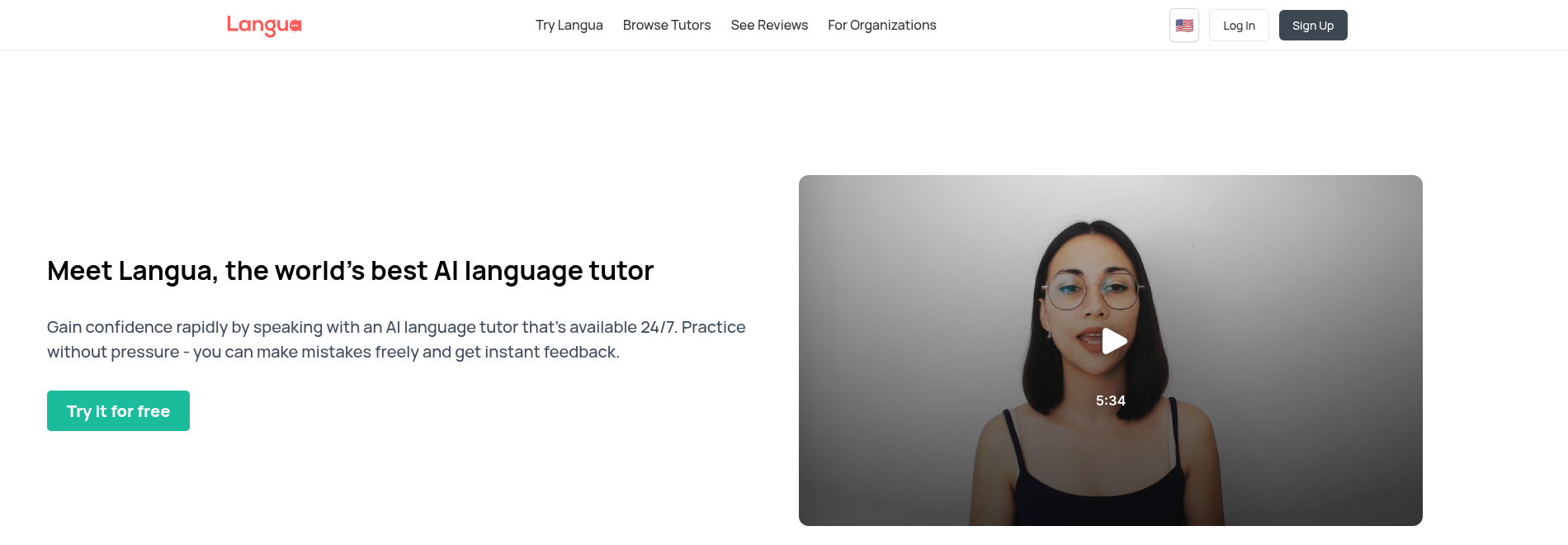
Langua is recommended by polyglots like Luca Lampariello, and is the most recommended tool when you ask ChatGPT for the best AI for learning languages. Instead of tapping answers, you have spoken conversations with AI tutors, and you get corrections as you go.
What it does better than Duolingo:
- A wide choice of conversation practice. There are realistic roleplays (ordering food, a job interview, sorting out a delayed train), debates, conversations about your own interests, and exercises built around the vocabulary you're learning.
- A guided course for beginners. Beginners don't have to jump straight into open conversation. The guided course gets you speaking straight away while teaching the most important vocabulary for daily life and travel, unlike Duolingo, which is often criticized for teaching useless vocabulary.
- Feedback with real depth. You choose subtle corrections (woven into the tutor's reply) or explicit ones, and you can have them written or spoken. With verbal corrections, Langua asks you to repeat the correct version out loud. After each chat, you can generate a report summarizing your mistakes, and Langua builds personalized grammar drills from them.
- Voices that sound human. The voices are cloned from real native speakers, with regional accents to choose from (for example, Mexican or Castilian Spanish), and you can slow them down.
- Vocabulary built in. Tap any word for an instant translation with usage examples, then save it to review as flashcards, practice in Vocab Conversations or use in AI-generated stories.
- Built around you. Lots of settings and personalization, from the dialect you hear to My Path, which suggests activities based on your interests.
Where Duolingo still wins: Duolingo has stronger game mechanics, a bigger free tier and more languages. For an absolute beginner who just wants a light daily habit, Duolingo is the easier start.
Price: from $12.50 a month (Standard, billed annually) to $29.99 a month (Unlimited, billed monthly), with a free trial.
italki
Best for: learners who want to talk to a real person.
Not ideal for: anyone who wants practice on demand, or on a tight budget for daily practice.
italki is a large marketplace of tutors in 150+ languages. Community tutors (native speakers focused on conversation) typically charge about $10 to $25 a lesson, and professional teachers about $15 to $40. Trial lessons are usually discounted.
Nothing replaces a real conversation partner who can read your face, pick up on what you mean and adapt on the spot. The trade-offs are cost, scheduling and variable quality: with thousands of tutors, finding a good one can take a few tries.
We also run a tutoring marketplace, LanguaTalk. It has a much smaller range of tutors than italki, but they're chosen more carefully.
Where Duolingo still wins: price and availability. Duolingo is there at 2 a.m. for free, and a human tutor isn't.
Tip: many learners combine both: daily AI practice to build fluency and fix mistakes, and a weekly human lesson to put it to the test.
ChatGPT and Gemini (the do-it-yourself option)
Best for: budget-conscious learners who are happy to design their own practice.
Not ideal for: beginners, or anyone who wants a ready-made learning system.
General AI chatbots can be surprisingly good conversation partners. Ask ChatGPT or Gemini to roleplay a café, explain a grammar point or simplify an article, and you'll get a useful result.
The catch is that they aren't built for learning. You have to write and rewrite prompts, ask repeatedly for corrections, and keep track of new words yourself. In voice mode, the AI speaks at native speed, and it tends to speed back up even when you ask it to slow down.
Price: free with usage limits. ChatGPT Go is $8 a month and ChatGPT Plus is $20 a month.
Best Duolingo alternatives for a structured course
If you like Duolingo's step-by-step path but want more depth and proper explanations, a structured course is the natural next step.
Babbel
Best for: learners who want clear grammar explanations and practical dialogues.
Not ideal for: anyone who needs lots of open-ended speaking practice, or who wants a free option.
Babbel teaches through short lessons built around realistic dialogues, with grammar explained along the way. That's the biggest difference from Duolingo, where you're mostly left to infer the rules. It covers 14 languages.
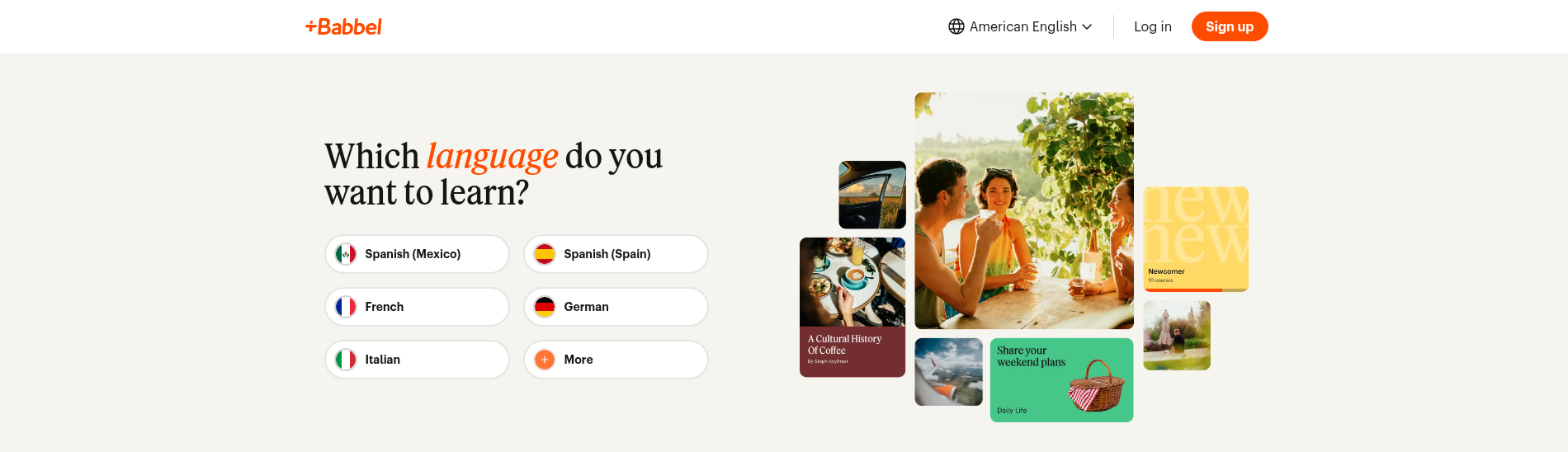
Babbel has also launched Babbel Speak, an AI conversation feature that went into beta in September 2025 for its main languages, but in our testing, it was far behind the latest AI tutors. Its live group classes for consumers (Babbel Live) were closed in 2025.
Where Duolingo still wins: a free plan (Babbel only offers a free first lesson) and stronger motivation features.
Price: about $18 a month on a monthly plan, or around $9 a month on an annual plan. A lifetime option is about $300.
Busuu
Best for: learners who want a CEFR-aligned course, with feedback from native speakers.
Not ideal for: advanced learners, since several courses stop before the upper levels.
Busuu offers 14 courses organized by CEFR level. Its standout feature is community feedback: you submit written or spoken exercises and native speakers correct them. That's available even on the free plan.
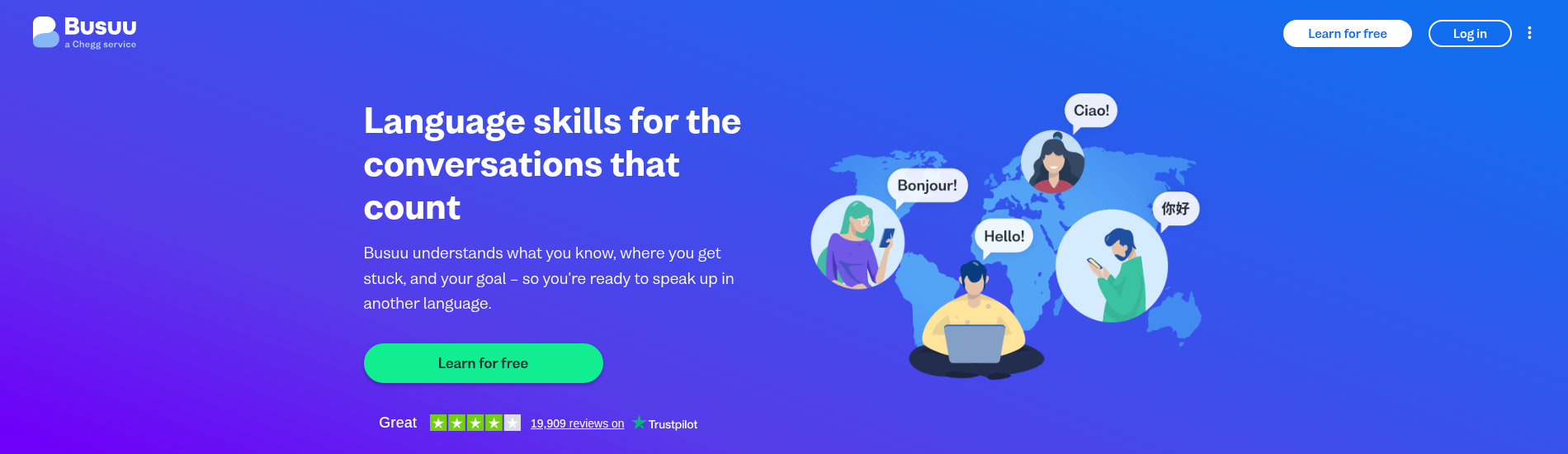
The free plan covers the essential course. Premium adds grammar and vocabulary review and offline mode, and Premium Plus adds AI conversations and pronunciation feedback.
Where Duolingo still wins: more languages and a more engaging daily habit loop.
Price: free plan, with paid Premium and Premium Plus plans. Prices vary by platform and country.
Rocket Languages
Best for: learners who prefer to pay once and work through a long, detailed course.
Not ideal for: anyone who wants conversation practice that goes beyond scripted phrases.
Rocket Languages offers in-depth audio lessons, culture notes and grammar lessons in 14 languages. For speaking, you record yourself and compare your pronunciation with a native speaker's. You pay once per level and keep lifetime access, with a 60-day money-back guarantee.
Where Duolingo still wins: it's free to start, and much lighter and more fun for a daily habit.
Price: about $150 per level at full price, but sales are frequent, so it's rarely worth paying list price.
Best for listening: podcasts and YouTube (no app needed)
You don't need an app for listening practice. Some of the best free resources are podcasts and YouTube channels made specifically for learners:
- Easy Languages (YouTube): street interviews with real people, subtitled in the target language and English. There are channels for many languages, including Easy Spanish, Easy German and Easy French.
- Dreaming Spanish (YouTube and its own site): thousands of hours of videos sorted by level, built around comprehensible input.
- Coffee Break podcasts: structured audio lessons that progress gradually, for several languages.
- Learner podcasts at your level: search for your target language plus podcast for learners (for example, Spanish podcast for learners), then pick one where you understand roughly 70 to 80 percent.
- LanguaTalk's own podcasts: free Spanish, French and Italian podcasts with transcripts.
The main limitation is that unknown words go by quickly, and there's nowhere to save them. If that bothers you, tools like Langua and LingQ add interactive transcripts, so you can tap a word for a translation and save it to review later. But start free and see if you need them.
Best for vocabulary
Duolingo introduces words, but it's not designed to make sure you still know them in six months. These tools are.
Anki
Best for: self-motivated learners who want a free, powerful flashcard system.
Not ideal for: anyone who doesn't want to spend time setting up and curating cards.
Anki is a spaced-repetition flashcard app: it schedules each card just before you're likely to forget it. It works for any language, and you can add audio, images and example sentences. Anki is free on desktop, web and Android, and AnkiMobile on iOS is a one-time $24.99.

Anki isn't a course, though. You decide what to learn and make or find the cards, and many people abandon it once the daily reviews pile up.
Memrise
Best for: learning everyday words and phrases with video clips of native speakers.
Not ideal for: grammar, or learners past the intermediate stage.
Memrise builds its lessons around short clips of real people saying useful phrases, which helps with listening and pronunciation as well as vocabulary. It also has an AI roleplay partner, MemBot, which is limited on the free plan.
The downsides are worth knowing, though. Memrise is strongest for beginners: it teaches little grammar, and the official courses thin out past the basics (PCMag rates it 3 out of 5 and dropped its Editors' Choice award). A 2024 redesign moved the popular community-made courses out of the app, which upset many longtime users, and you now have less control over reviewing words, with some free users reporting a daily cap on reviews in 2026. MemBot's conversations are fairly basic, and the newer AI role-play feature needs Pro. The monthly price of $24.99 is also steep, the deals keep changing, and its Trustpilot score is just 1.7 out of 5.
Price: free plan available. Pro is $61.99 a year (about $5 a month) or $24.99 month to month.
Langua
Langua's vocabulary tools are built into its conversations rather than sitting in a separate app. You save words with one tap from a chat, podcast or video, then review them as spaced-repetition flashcards.
What sets it apart is Vocab Conversations: the AI deliberately steers a conversation so that you use the words you're currently learning. You can also generate short stories that include your saved words, narrated by native voices.
Best for grammar
If you're tired of guessing why an answer is wrong, these tools focus on grammar directly.
Kwiziq
Best for: French and Spanish learners who want to know exactly which grammar points they're weak on.
Kwiziq gives you short adaptive grammar quizzes, then maps your strengths and weaknesses by CEFR level and builds a study plan around the gaps. It's one of the most targeted grammar tools we tested. The downside is that it only covers French and Spanish.
Price: the free plan includes 10 quizzes a month. Premium is about $11.50 a month on an annual plan, or about $31.50 billed monthly.
Other grammar tools
Here are four other tools that are also helpful for grammar:
- Lingolia: clear grammar explanations with exercises for German, French, Spanish and English. Much of it is free.
- Conjuguemos: free verb conjugation drills for Spanish, French, German, Italian and more.
- Langua: builds grammar drills from the mistakes you make in conversation, so you practice exactly what you got wrong while speaking. You can also create custom exercises on any grammar topic.
- Reverso Conjugation: a free conjugation lookup for many languages, handy for checking any verb form in seconds.
The best free Duolingo alternatives
If you'd rather not pay, these are genuinely useful for free:
- Podcasts and YouTube for listening, as above.
- Anki for vocabulary (free except on iOS).
- Busuu's free plan for a structured course with community corrections.
- Kwiziq's free plan for 10 French or Spanish grammar quizzes a month.
- Lingolia, Conjuguemos and Reverso Conjugation for grammar explanations and drills.
- Language Transfer, a free audio course that teaches you to build sentences by thinking through how the language works.
- ChatGPT or Gemini (free versions) for conversation practice, if you're happy to write your own prompts.
How to combine Duolingo with other apps
Apps work best with a plan. Here are three simple routines, depending on your level and budget:
1. Beginner, about 20 minutes a day
- Duolingo or the Langua guided course: 10 minutes.
- A learner podcast or Easy Languages video: 10 minutes.
2. Stuck at A2 or B1 and can't speak, about 30 minutes a day
- AI speaking practice (Langua): 15 minutes.
- Listening with transcripts: 10 minutes.
- Review the words you saved: 5 minutes.
- Optional: one human lesson a week (italki or LanguaTalk).
3. Free only, about 25 minutes a day
- Duolingo (free) or Busuu (free): 10 minutes.
- Anki: 5 minutes.
- Podcasts or YouTube: 10 minutes.
- Once a week, a 15-minute ChatGPT roleplay.
Conclusion
Duolingo is a good way to build a daily habit, but on its own it won't get most people speaking confidently. The best move is usually to keep what works and add one tool for your weak spot: AI conversation practice or a human tutor for speaking, a structured course for grammar, flashcards for vocabulary, and podcasts or YouTube for listening.
Frequently asked questions
What's better than Duolingo?
It depends on what you need. For speaking, Langua (artificial intelligence) or italki (human tutors) give you far more helpful practice. For a structured course with explanations, Babbel or Busuu. For vocabulary, Anki. Duolingo is still hard to beat for building a daily habit, so many learners keep it and add one of these.
What's the best free Duolingo alternative?
There's no single free app that does everything. The best free combination is podcasts and YouTube for listening, Anki for vocabulary, Busuu's free plan for a structured course and a free AI chatbot for conversation practice.
Which Duolingo alternative is best for speaking?
Langua is our pick for speaking practice, because it combines open conversation, a guided course for beginners and detailed corrections. If you want a human, italki and LanguaTalk connect you with tutors for live lessons. Duolingo's own Video Call is useful but more limited.
Can you become fluent with Duolingo alone?
Unlikely. The majority of Duolingo courses stop around A2 level, and even the nine courses that now reach B2 give limited practice speaking freely or understanding natural-speed conversation. It's a useful foundation, but you'll need speaking practice and real listening input to become fluent.
Are Pimsleur or Rosetta Stone good Duolingo alternatives?
Both are well known, but we don't recommend either as a first choice.
Pimsleur is an audio course of 30-minute lessons where you repeat and recall phrases. It can help with learning practical phrases early on, but critics such as polyglot Steve Kaufmann point out:
- It covers a small amount of vocabulary and moves slowly, with a lot of English in each lesson.
- The core audio lessons have no transcripts.
- The conversations are scripted, so it's better as a starter than for getting past the beginner stage.
Repeating phrases also doesn't teach you how the language works, or fully prepare you for responding in real life. For another hands-free option that talks back, try Langua's AI-powered guided course. Like Pimsleur, in each lesson you learn practical phrases for travel and daily life, but you also learn the logic behind the language, and apply them in a roleplay.
Rosetta Stone teaches through pictures, with no translations or grammar explanations. Some learners like the immersion, but reviewers report several problems:
- Picture tasks can be passed by guessing.
- Some content doesn't fit the culture of the language being taught.
- Its speech recognition sometimes marks correct answers wrong, and wrong answers right.
There have also been many complaints about subscription renewals being charged at higher prices than customers first paid. One US law firm has been collecting these complaints for a possible investigation.
Is Duolingo Max worth it in 2026?
Probably not, for most learners. Its main AI feature, Video Call, has been moving into the cheaper Super plan during 2026. Duolingo has also said it's reviewing whether to keep Max at all. If AI speaking practice is your priority, a dedicated app will give you more for a similar price.